In this article WagerWire co-founder Travis Geiger poses the question “is April Fools Day ethical?” || sets in motion a dubious prank of his own || and finds life imitating art 🎭
[4 minute read] [best read in the voice of Orson Welles]
“Prankvertising” is the term sometimes given to the genre of marketing that just invaded our lives yesterday, as it does every April Fools Day. As a holiday it's a bit demented, but conceptually I’m all for it. Comedy has been called the art of lying. It has also been said to be the ultimate form of truth.
As a self styled student of the holiday, I identified an opportunity for WagerWire to get in on the fun this year. The goal? A cheeky reinforcement of the benefit of WagerWire’s free betting tools - namely our apps ability to verify the authenticity of sports bets and fantasy entries.
The plan was simple: create a faux bet slip of a wild longshot parlay that’s one leg away from an incredible payout. Then create a backstory for the bettor and a humorous scenario for what they’ll do with the winnings. A story you’ve seen before, but with a twist.
The grand reveal would shed light on how the slip was fake and without WagerWire it's impossible to know if any of the thousands of screenshotted slips are legit.
The ethical quandaries began immediately.
To pull this off I would have to employ the same tactics used by scammers, hostile governments and anarchists because digital April Fools pranks are at their core misinformation campaigns. So I sat down with our intern Jacob and began to plot.
Step one would mean forging a bet slip.
Screenshots of bet slips have evolved into a media genre unto themselves. In lieu of effective share buttons and social features the socialscape has become awash in these rectangles.
But it turns out creating a faux bet slip in the style of any major American sportsbook takes a capable intern roughly 45 minutes. This begs the question, with so many bettors/touts flexing on screenshots, how can we be sure any of them are real?
At 7:59pm - As I write this - @BR_Betting has just posted a bet slip being disputed as fake in the comments.
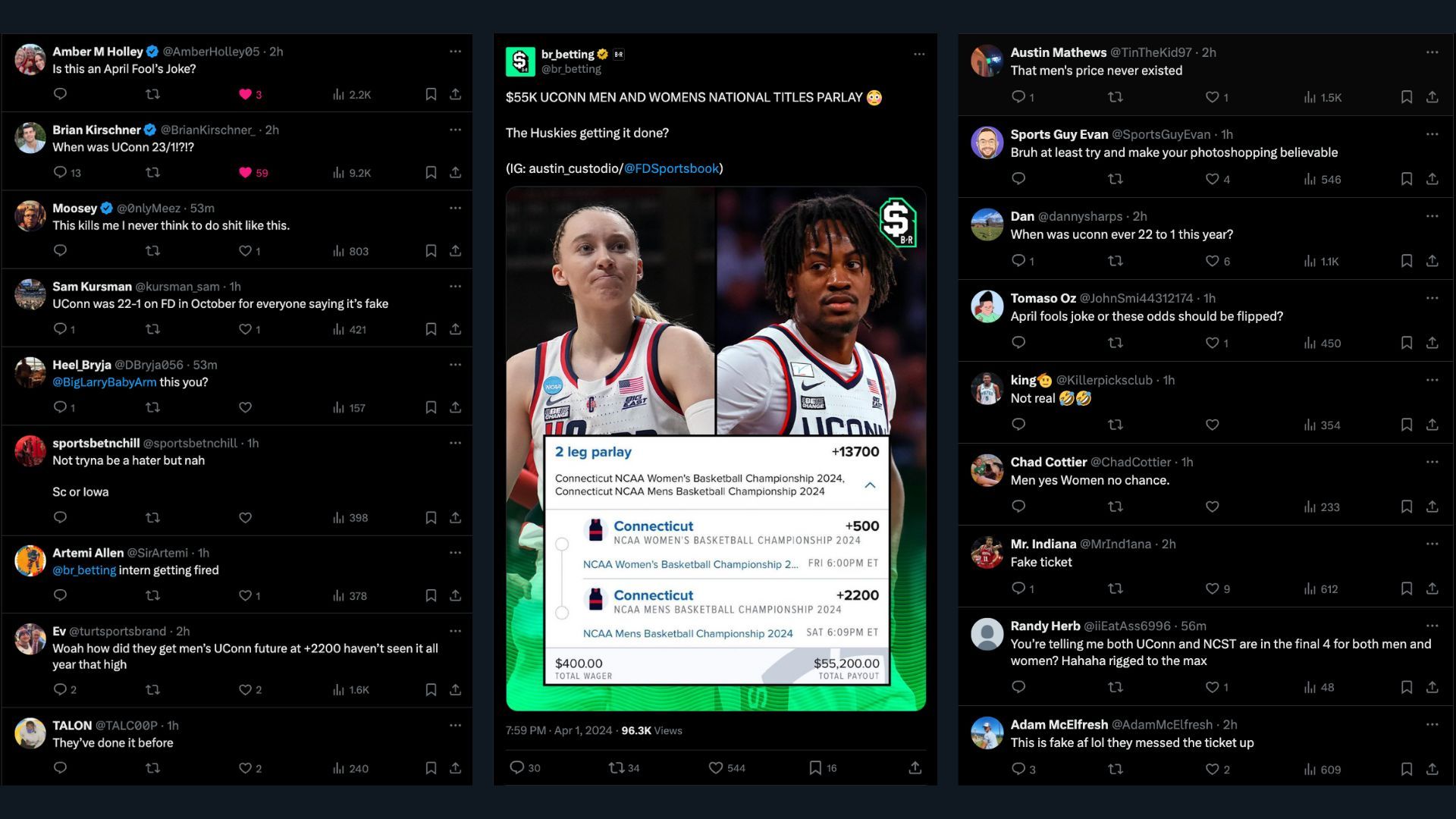
We cannot confirm if this bet is real or fake. We ran the numbers and believe it is a statistical improbability that these Mens and Womens odds existed simultaneously. So what does BR do in this scenario? As of midnight 100,000 people had seen this disputed ticket on X, and while some are vouching for it in the comments hundreds have commented questioning its authenticity. It seems our prank has stumbled onto some real truth…
Back to the “prank”
As evidenced above, a bet slip from a US app would hit too close to home and stir up unwanted confusion. So we decided to spoof an offshore book. Macau seemed like a nice spot for some whale action - and it would allow us to make the action more sensational than any US sportsbook would take while obscuring the details in Chinese characters and HKD payouts.
We would need a fake source to link this fake bet to. So we purchased tmz-china.com and created the very fake news site “TMZ China.” We used ChatGPT to fill the site with articles in the style of a gossip columnist complete with annoying fake banner ads.
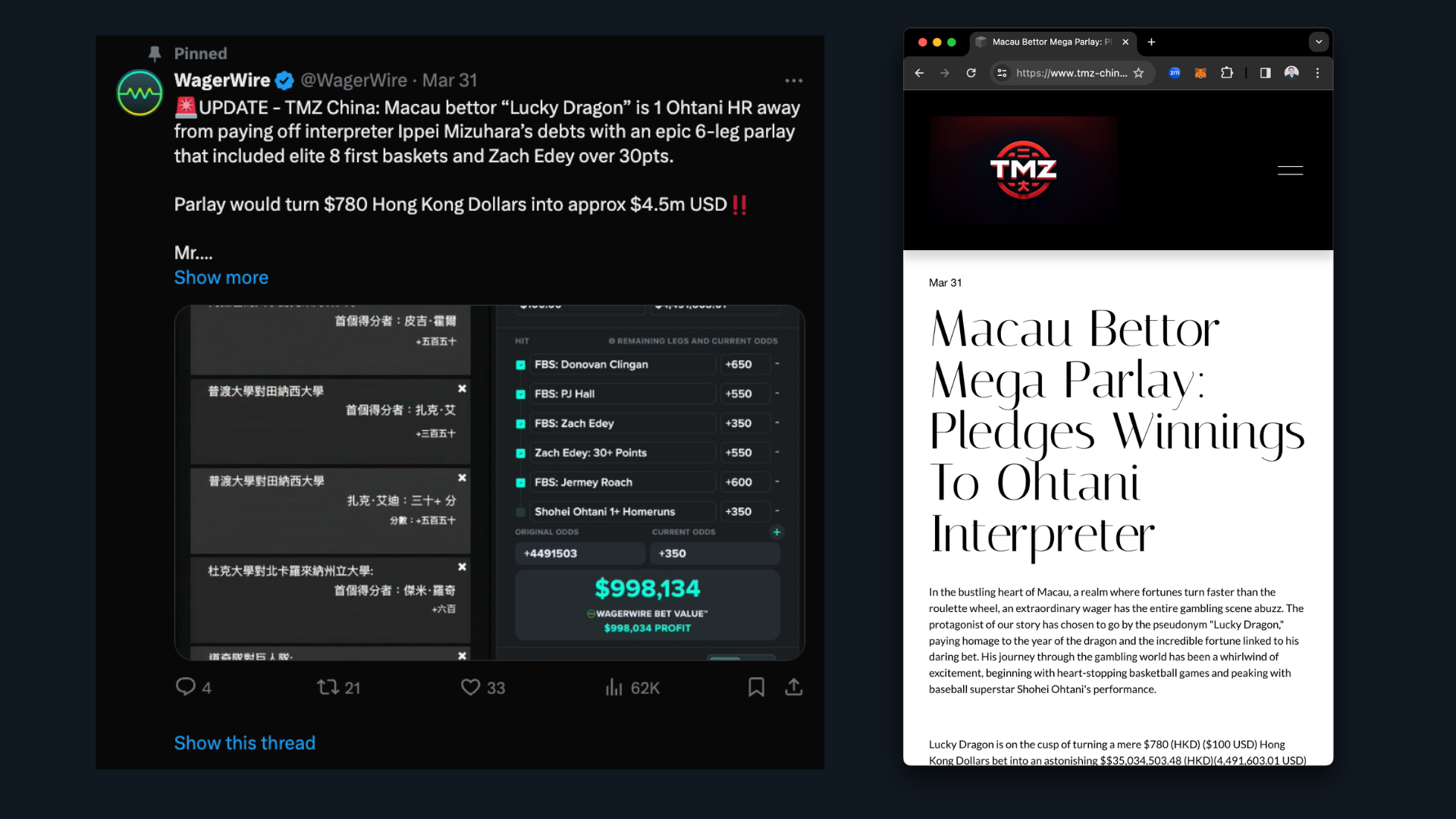
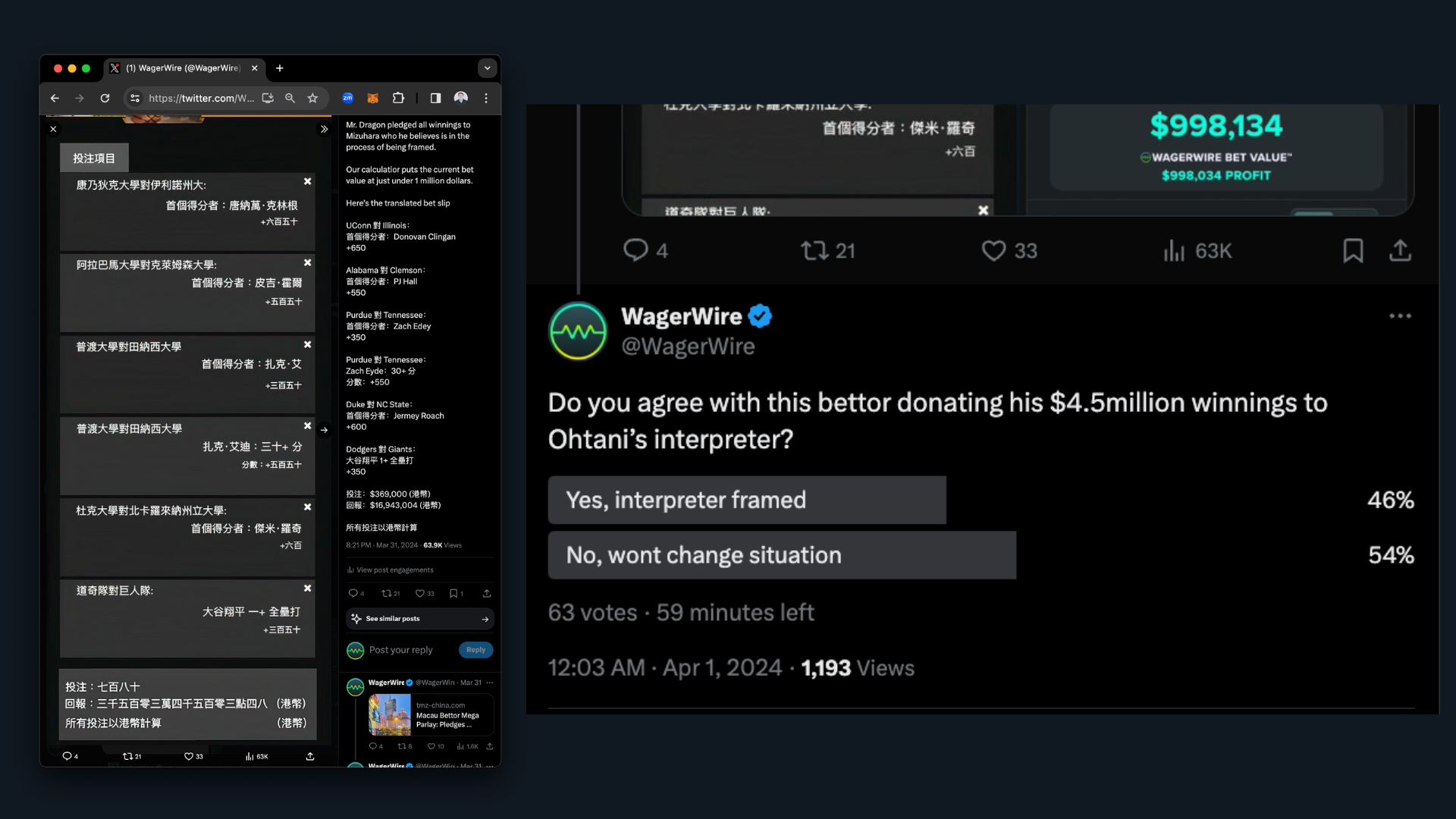
We created a 6-leg parlay that played out over the Elite 8 weekend consisting of four first baskets and Zach Edey over 30 pts (he hit 44) ending an Ohtani Over 1 HR vs the Giants the night of April 1st.
Then we tweeted it out and linked our TMZ China article “Macau Bettor Mega Parlay: Pledges Winnings To Ohtani Interpreter”
Our fake story gained tens of thousands of impressions in hours
The bettor “has chosen to go by the pseudonym "Lucky Dragon," paying homage to the year of the dragon and the incredible fortune linked to his daring bet.” (source: TMZ China).
Objectively, I think there are different levels of comedy to appreciate here, not the least of which is pledging gambling winnings to pay off someone else’s gambling debt and that 63 people felt compelled enough by the story of Lucky Dragon’s bet to express their opinion in a survey about the fake matter.
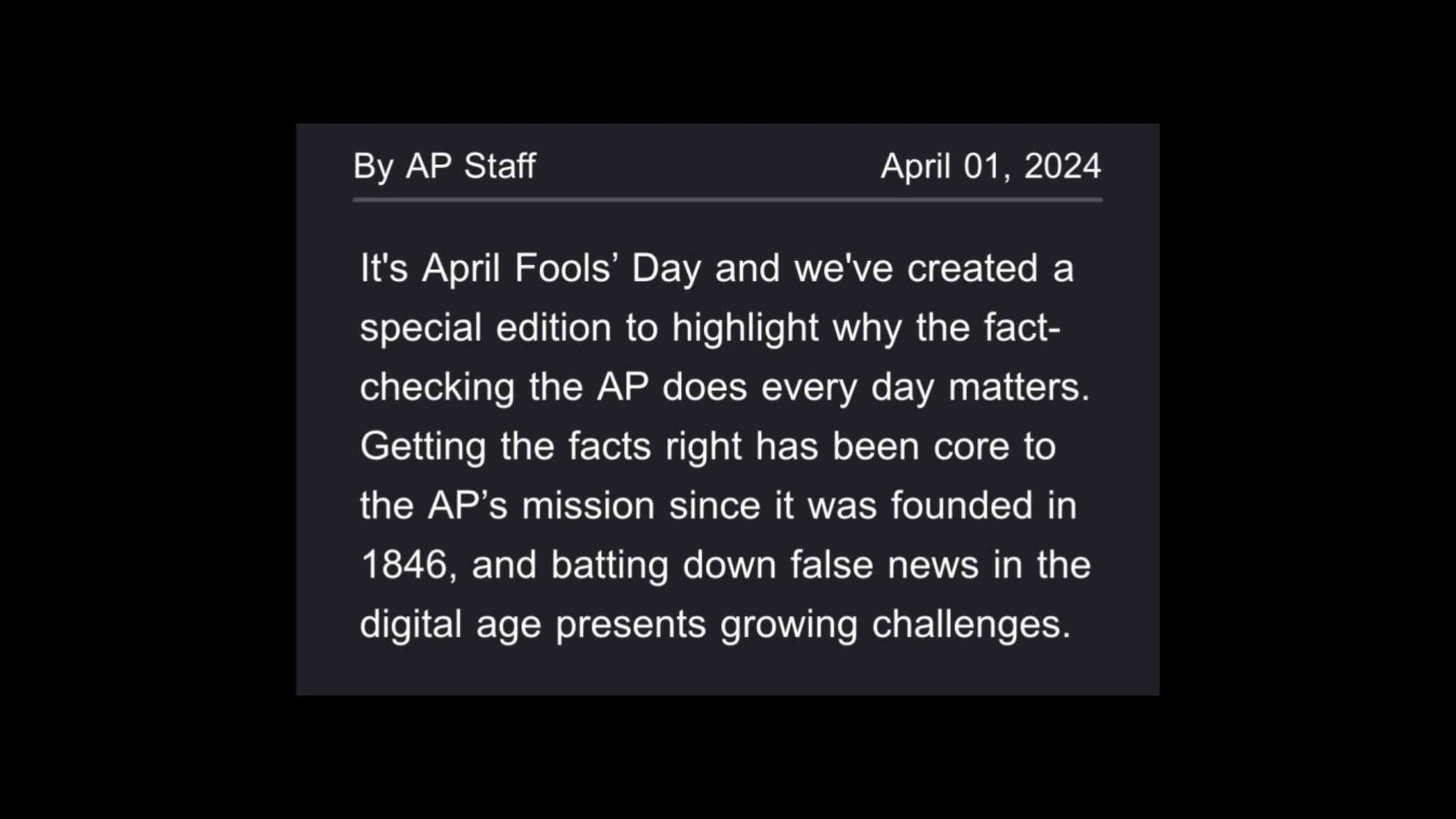
Thankfully no journalists fell for our trap. In fact, the free press had a bit of a moment this ‘fools day. Several prominent outlets used the holiday to shine a light on mis-and-dis-information.
The Associated Press, for example, created a special April 1 edition of their “Morning Wire” newsletter to highlight fact checking.
The ease of this caper remains unsettling to me.
When breaking down the components: the ability to purchase a legit-sounding domain, then instantly populate it with AI, and disseminate over social media - one can’t help but think of the troll farms weaponizing this playbook for more sinister purposes. They’re doing it all day, every day, and they are getting hyper efficient at it.
The truth will prevail, but only if we stay hypervigilant.
Media has become inescapable. Certain protections need to be put in place to maintain public trust. Truth and lies, conspiracies, tragedies, and UFOs sightings now flow down the same river, and unfortunately it's the same river we all get our drinking water from. Trustworthy brands can help filter the toxic particles. We might not be able to stop the pollution, but we can make it healthier to consume. Bet verification is one such filter WagerWire is proud to offer the public for free. By syncing your betting and fantasy accounts to the WagerWire app, tickets are verified for authenticity and can be shared confidently on social media.
DOWNLOAD WAGERWIRE ON THE APP STORE

”Reality? It's the toothbrush, waiting at home for you in its glass. A bus ticket. A paycheck.” - Orson Welles (F for Fake, 1973)