At NEXTPredict NYC, DraftKings CEO Jason Robins sat down with CNBC's Contessa Brewer to discuss the future of prediction markets. What followed was a revealing look at how one of America's largest gambling companies plans to navigate an industry that could fundamentally change its business.
The biggest takeaway? DraftKings wants to embrace prediction markets without sacrificing the sportsbook empire it spent years building.
Playing Both Sides of the Regulatory Game
Robins claimed DraftKings had already become a top-three prediction market exchange just months after launching.
The advantage is obvious. DraftKings has years of experience understanding sports bettors, building products, and acquiring customers. But unlike newer competitors, DraftKings has a unique set of restrictions.
Robins explained that DraftKings won't offer sports prediction contracts in states where it holds sportsbook licenses, fearing the regulatory consequences.
Interestingly, when asked whether he'd prefer nationwide sportsbook legalization or the ability to offer prediction markets, Robins leaned toward prediction markets because of their potential beyond sports, including politics.
"Bet" or "Trade"? The Billion-Dollar Question
Perhaps the most revealing moment came when Brewer referred to placing a bet on a prediction market. Robins immediately corrected her: "you mean trade?"
The whole room laughed.
But the distinction is worth billions. Calling something a trade rather than a bet reinforces the argument that prediction markets fall under federal commodities oversight rather than traditional state gambling regulation. Everyone in that room knows what sports prediction contracts resemble. DraftKings certainly does. And if executives are comfortable laughing about the distinction, are prediction markets effectively laughing in regulators' faces?
When Does Entertainment Become Exploitation?
Things got more contentious when Brewer raised a New York Times investigation into DraftKings' use of AI to identify customers likely to respond to promotions and lose more money.
Robins strongly disputed the characterization, arguing that gambling losses shouldn't automatically be viewed negatively. He compared gambling to spending $100 on a nice bottle of wine. You're paying for entertainment, not necessarily expecting a financial return. There's logic to that argument but there's also an uncomfortable distinction.
A restaurant doesn't have an algorithm predicting how much money you're likely to lose before deciding which promotion to send you.
Robins was also questioned about a PROPUBLICA report regarding responsible gaming.
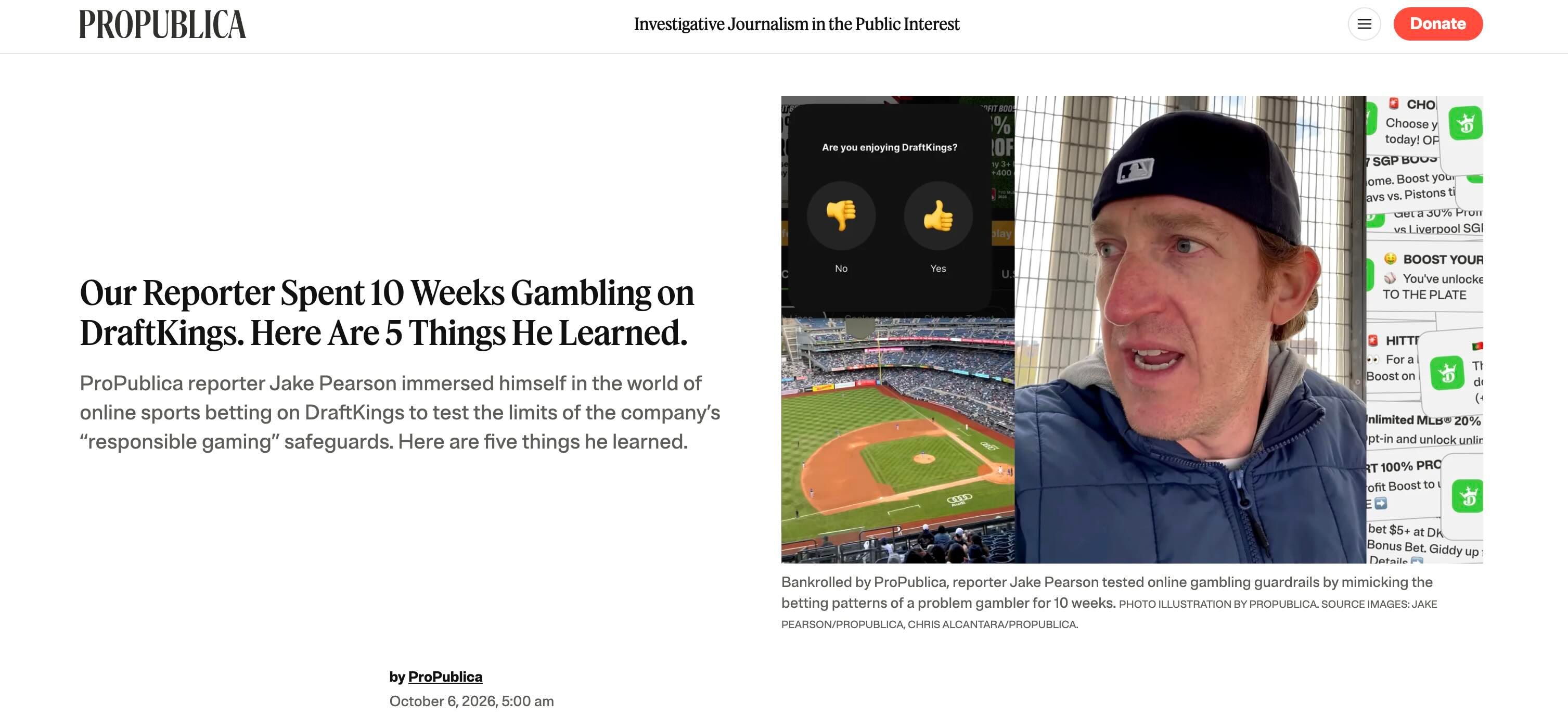
The reporter Jake Pearson went to X to respond to Robins comments on his story.
The DraftKings CEO defended their RG practices, pointing to customer outreach, account monitoring, and interventions for concerning behavior. He also argued that prematurely cutting customers off could simply push them toward another platform.
But that raises a bigger question: If companies can use AI to predict which customers will generate the most revenue, shouldn't they be equally aggressive about predicting which customers are most at risk?
The Endgame
DraftKings wants to lead the prediction market revolution without sacrificing the sportsbook empire it built, but that balancing act raises some uncomfortable questions. As the lines between betting and trading continue to blur, the industry must prove that innovation and profits don't come at the expense of consumer protection.
